
Commercial Roofing Services
Roof Drains, Scuppers and Ponding Correction in Pasadena, TX
A flat-roofed building with four drains and a June downpour is a matter of arithmetic. Houston collects roughly 50 inches of rain a year across about 104 rainy days, and June runs wettest. Every square foot of roof has to send its share to an outlet, and the outlet has to be open, sized for the load and sitting at the low point.
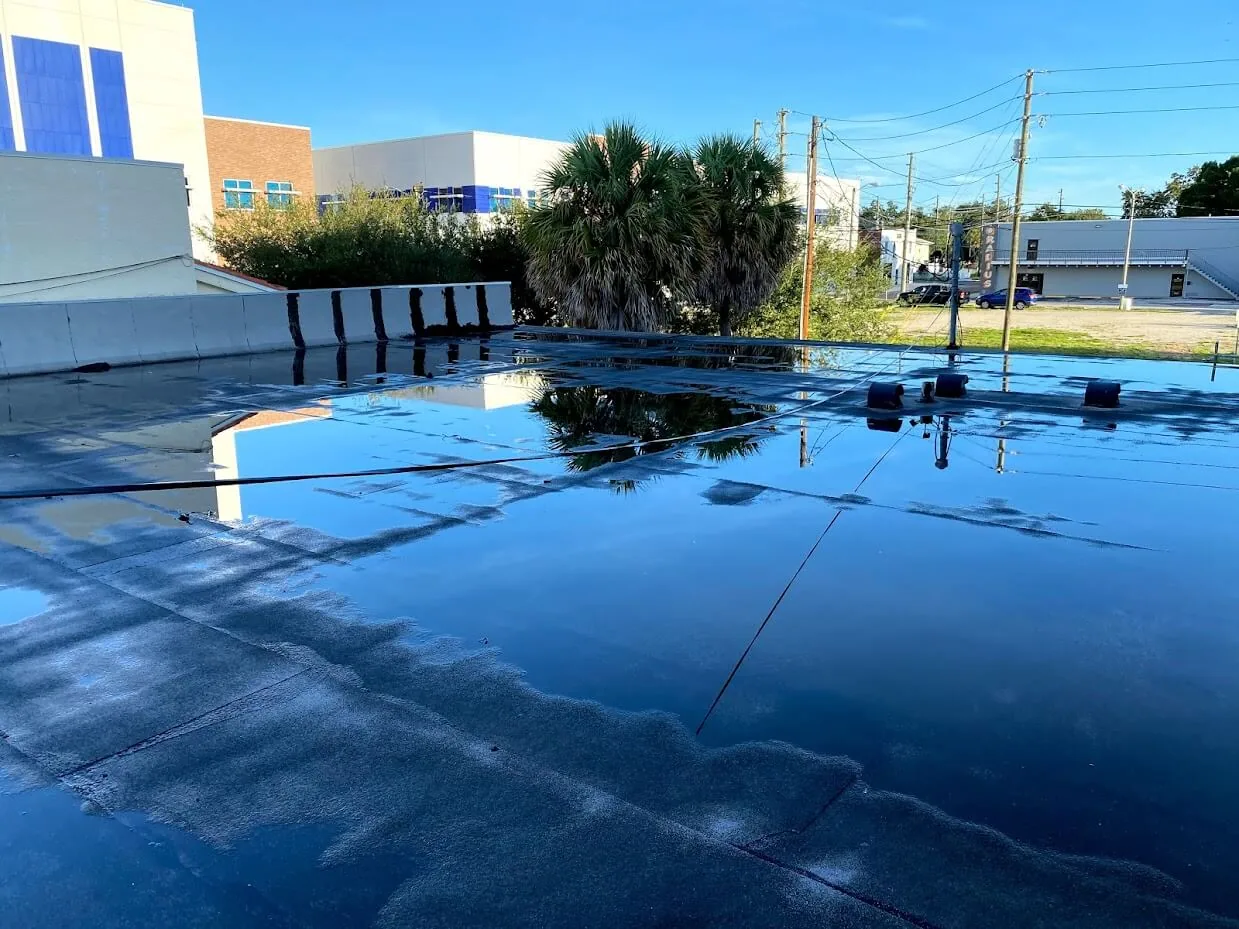
When any of those three fails, water stays. A puddle that lasts a day is a nuisance. One that lasts a week, over and over, loads the deck, softens the membrane and finds the first weak seam. Drainage work in Pasadena, TX is quiet, low-profile repair that protects almost everything else on the roof.
Count the Outlets Against the Rain the Roof Must Shed
The first question is whether the roof has enough drainage for the weather it gets. We map each drain area, the outlet serving it, any overflow path, and the slope between. Codes call for secondary drainage so water has somewhere to go when the primary drains clog, and an overflow scupper set above the main roof level does that job where an interior system cannot.
Older roofs often carry additions that outgrew their drainage: new rooftop units that dam the flow, a parapet extension that closed an old scupper, an infill wing that sent more water to a single bowl. Hurricane Harvey in August 2017 set the national mark for rain from a tropical cyclone, and a roof that drains fine in an ordinary storm can fall behind in a rain like.
Open Every Drain and Look Inside
A clean-looking strainer says little. We lift it and check the bowl, the clamping ring and the connection to the leader below. Cracked bowls, loose rings, corroded cast iron and sags in the membrane around the sump all show up with the strainer off. Where a leader is suspected, we flush it and watch the flow, and a camera run confirms what the flush suggests.
Scuppers get the same attention. A scupper that has been fitted with a liner that sits proud of the roof surface acts as a dam, not an outlet. A throat packed with sediment and leaves does the same. We check the height of every opening against the roof surface, because an inch of lip can hold a lot of water over a hot weekend.
Rebuild the Flashing Where Water Leaves the Roof
Outlets concentrate water, so their flashing carries a heavy workload. Drain flashings lose their seal where membrane is pulled tight around the bowl or where sealant has dried and split. Scupper throats fail where the liner meets the wall, and where the membrane turns the corner. Those spots often show up as stains on the wall below, which makes the leak look like a wall problem.
We cut out the failed detail, set a new flashing or liner in the membrane's own method, and test the result with water before moving on. A split drain flashing is a flashing failure in the plainest sense, and an active interior stain below a scupper is handled as a commercial roof leak on the same visit.
Add Crickets and Taper Where Water Stands
Ponding is a slope problem, and the cure is more slope. A cricket is a small, tapered saddle built behind a curb, a unit or a wall to push water around the obstruction and toward an outlet. Tapered insulation does the same job across a broader area, laid in the existing roof's low spots to build a gentle fall. Both are built into the assembly under new membrane, which is where the insulation and cover board layers earn their keep.
Before building anything, we confirm the cause. Settled deck, a missing drain, an outlet set too high and a sagging insulation board each call for a different fix. Good ponding water repair removes the cause instead of covering it with new membrane.
Coordinate the Plumbing Tie-In With the Building Engineer
Drain work touches the building's plumbing, so the sequence is agreed with the facility engineer first. Replacing a bowl means closing a leader for a short window, and interior leaders run through occupied space, above ceilings and beside walls. We stage the work in sections, protect the interior where a pipe is opened, and set the shutoff times to match the building's day.
A hospital on Spencer Highway or a plant with continuous process lines needs a work plan that names the leaders, the dates and who confirms each one back in service. On exterior systems, gutters and downspouts get the same check, and the perimeter pieces that carry that water, the edge metal and gutters, get looked at on the same walk.
Keep Outlets Clear Between Storm Seasons
A corrected drain system still needs care. Debris returns after every windy week, and a single blocked bowl turns a good roof into a retention pond. The simplest protection is a clearing visit before the wet months and another after major storms, built into a preventive roof maintenance schedule. We note standing-water locations on the photo record so any change from the last visit stands out.
After a correction, we recheck a day after the first real rain. If water is still standing, the fix is not finished. The recheck is part of the job, not a callback.
When water remains after a correction, use a level or other appropriate measurement to distinguish a low roof plane from a blocked outlet or an undersized connection. Confirm that the drain bowl, strainer, leader, and downstream path are clear before changing the membrane slope. Where a plumbing contractor must open a line, coordinate responsibility for restoring the roof flashing and testing the finished connection. Photograph the same low points after rainfall so the owner can see whether ponding duration changed. Record any areas that need structural or design review rather than adding tapered material by assumption. This keeps drainage work tied to a verified cause.
Commercial Roofing Questions
How long can water sit on a flat roof before it counts as ponding?
Most manufacturers treat water still standing 48 hours after rain as ponding, though the exact wording varies by warranty. In Houston heat, a puddle that lasts that long is already doing damage to seams and surface, so we flag anything beyond a day.
Are scuppers or interior drains better for a flat commercial roof?
Neither wins every time. Interior drains keep water inside the footprint and away from the walls, and scuppers are simple, visible and easy to clear. Many buildings combine the two, with scuppers set higher as the overflow path, and the right mix follows the building's parapets, its layout and its slope.
Our drains are clear but water still stands. What else could it be?
Look at the deck and the insulation. A deck that has settled or insulation that has compressed creates a bowl no drain can reach. Outlets set above the surrounding membrane do the same. A survey with a level or laser maps the high and low points and shows whether crickets or taper will solve it.
Can drain work happen during a shift without interrupting the operation?
Usually, with planning. Most of the work is on the roof, and the interior pipe work is short and staged. We agree the leader shutoffs with the building engineer, keep protection below any opening and confirm each leader back in service before leaving.
Will adding crickets change my roof warranty?
Modifying a roof can affect warranty terms, so check the document first. Crickets and taper are built with the same membrane and insulation systems the manufacturer already accepts, and we document the added components so the warranty file stays complete and the manufacturer can review it.
Keep Reading
Related Roofing Work in Pasadena


Walk the Drainage With Us After the Next Rain
Show us where water stands. We will walk the roof with your facility director and the building engineer, open every outlet and map the fix so the work fits your schedule.