
Service Areas
Commercial Roofing in Nassau Bay, TX
A commercial building in Nassau Bay works inside a small footprint. The city covers 1.75 square miles of land and water, it faces the Johnson Space Center across NASA Road 1, and it is bordered by Clear Lake, Carlton Bayou and Swan Lagoon. For a facility director that adds up to one planning problem before any membrane is opened: where do the trucks, the crane and the material staging go when the lot is shared and the water is close?
We start there. The roof plan for a Nassau Bay building is written from the ground up, around the doors, the tenants and the shift schedule, and only afterward around the roof system. Low-slope and metal roofs get inspected, repaired, recovered or replaced in sections small enough to dry in the same day. It is a logistics job with a membrane on top of it.
Ask What Has to Keep Running
Whatever a Nassau Bay building houses, one thing inside it cannot stop, and the roof plan protects that thing first. A clinic suite keeps appointments, a restaurant keeps a kitchen line, an office keeps servers and a lease. We ask which room, which hour and which tenant, then write the sequence to match. Nobody should learn on the first morning of a tear-off that the network closet sits under the section we just opened.
If the roof covers a school building, the calendar takes over. Clear Creek ISD serves the city, and a district building has a summer shutdown window that does not stretch. A scope that cannot finish by August gets split into phases that leave every classroom dry when students return.
Night shift work is an option on some buildings. It costs more per hour and saves more per day. We price both versions so the owner chooses with real numbers in front of them.
Stage the Laydown Area Inside a Small Footprint
With 1.75 square miles to share, Nassau Bay does not leave a contractor much room to spread out, so the lift plan and the laydown area get settled early, usually on a walk with the property manager and a site sketch. We mark where the crane pick lands, where rolls of membrane and pallets of insulation are staged, how tenants and delivery trucks keep moving around them, and what happens to those stacks if a storm cell builds off the lake in the afternoon. Material comes up in the amount the crew will install that day. Nothing sits open overnight.
The Johnson Space Center across NASA Road 1 occupies 1,620 acres with roughly 100 buildings and employs about 12,500 civil servants and contractors. A workday on a campus that size is a reason to ask early about delivery windows and shift changes next door, because a truck that reaches the curb at the wrong hour can lose a morning. That question belongs on the walk, not on the morning of the pick.
Clear Lake City and Webster, both beside the space center, raise the same staging questions, and the answers rarely transfer from one lot to the next without a walk.
Specify for Lake Air and Constant Humidity
Open water on the city's edges puts humid air against every roof. Houston's summer numbers apply here too: an August high averaging near 95 F, temperatures of 90 F or more on about 102 days of the year, and mornings with humidity over 90 percent. A dark membrane under that load swells and relaxes daily, and the roof never gets a dry season to recover in.
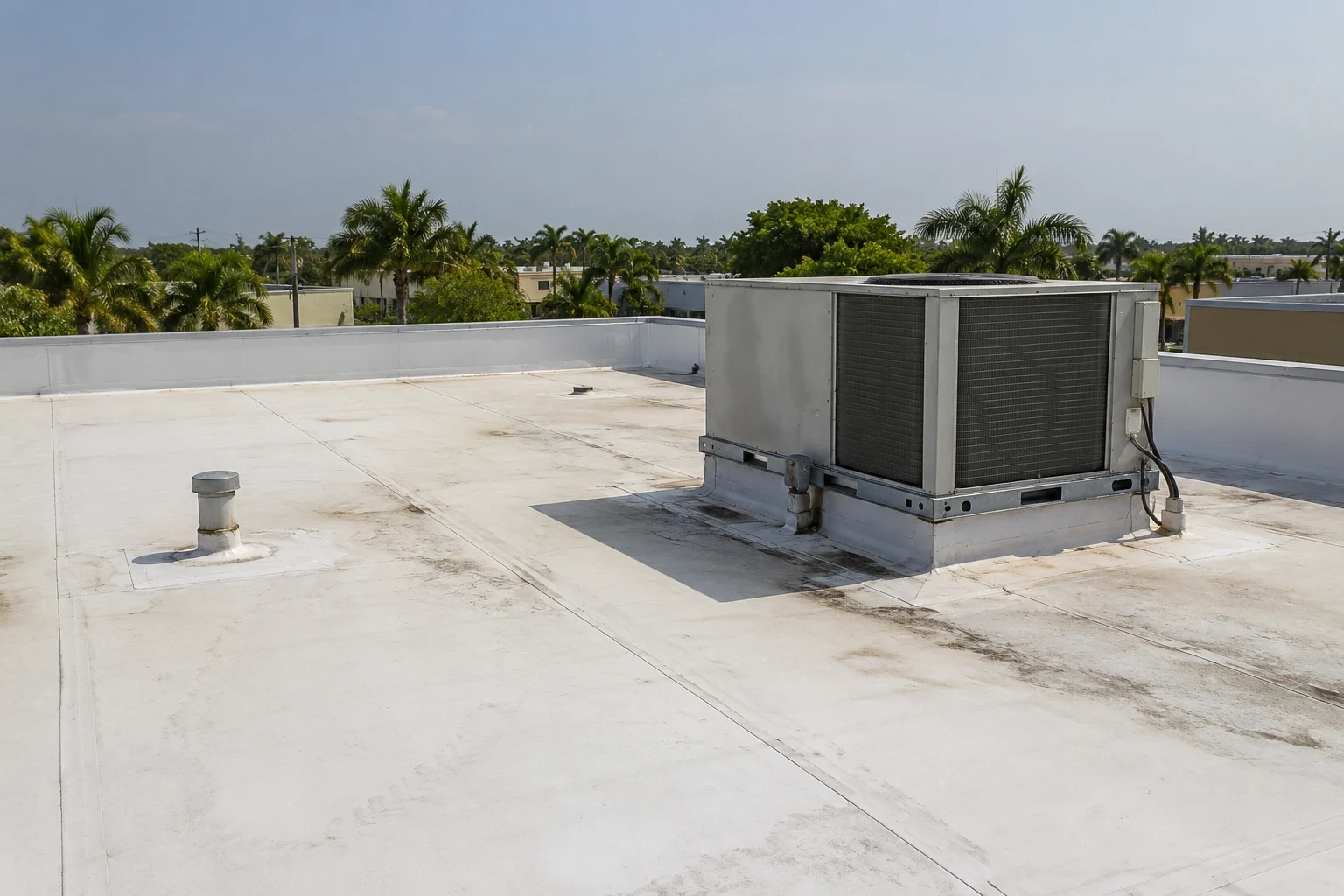
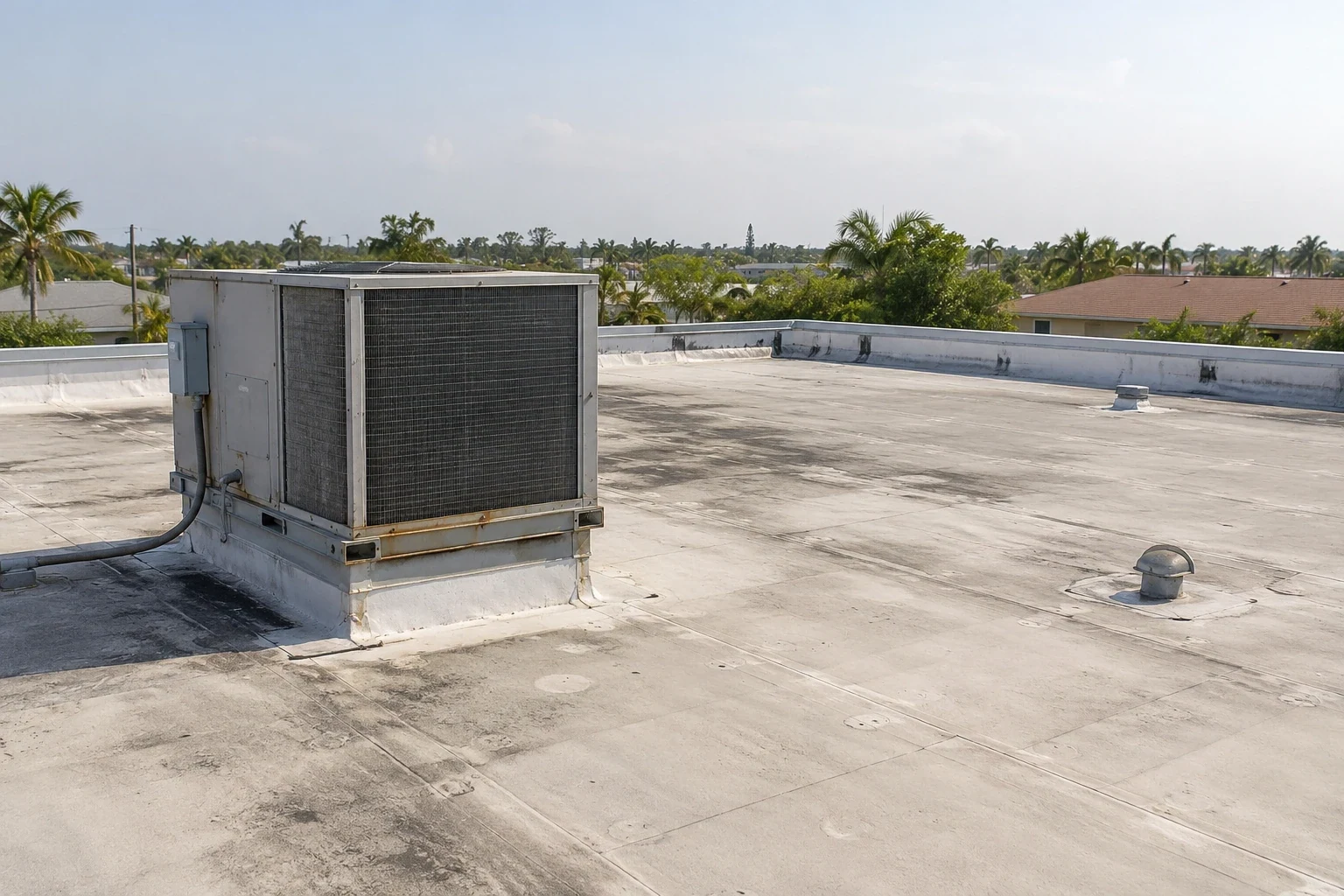
A white TPO sheet reflects the heat and welds into one continuous surface, which is why it is the usual choice for a plain low-slope roof. Where rooftop kitchen exhaust or chemical vents put grease on the surface, PVC resists it better. Corrosion is the quieter problem. Fastener heads, edge metal, unit frames and curb flashings rust first in damp air, so we look at those before we look at the field of the roof, and we specify coated or stainless hardware on the replacement.
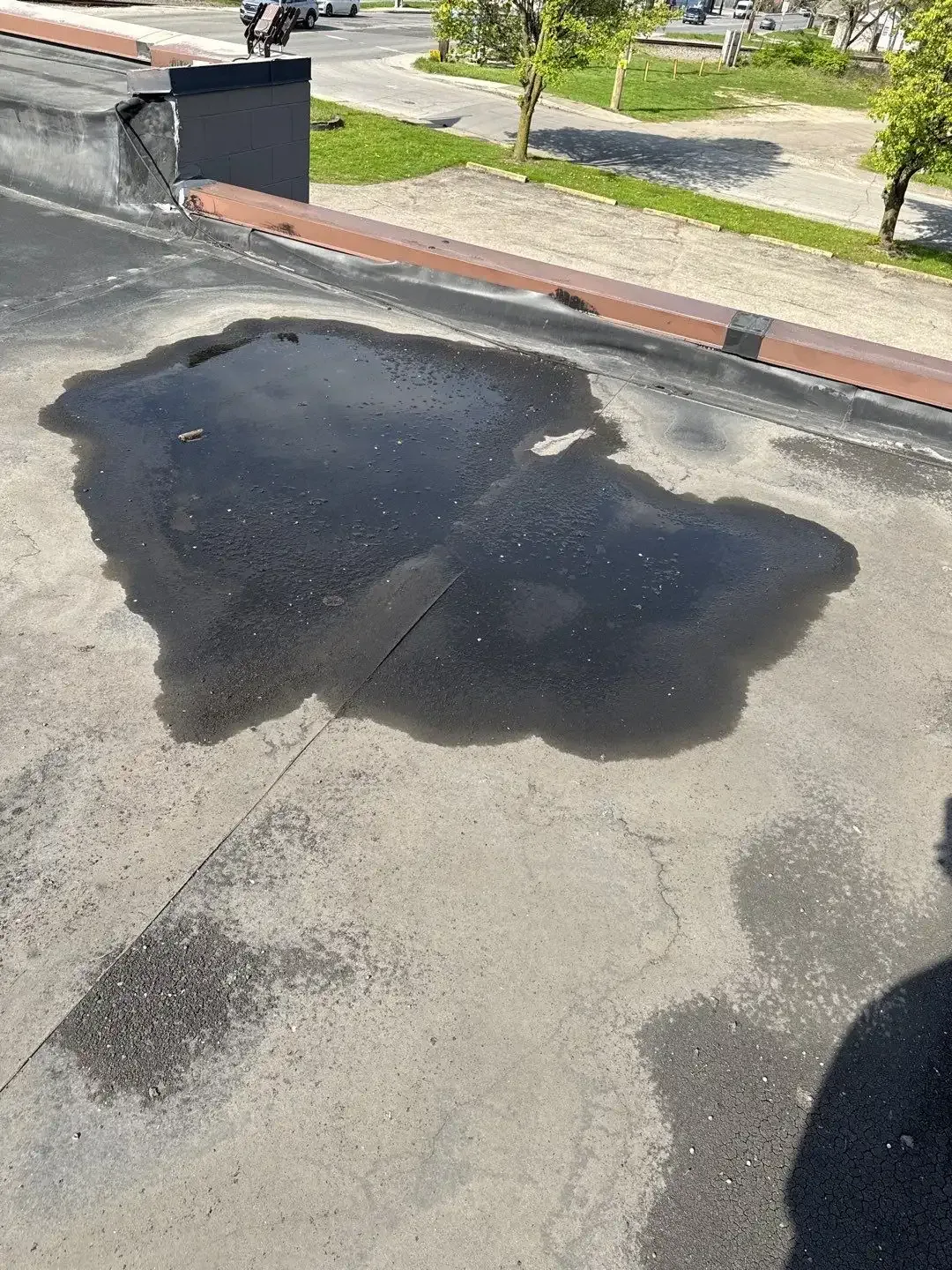
Rain adds its own load. Houston gets roughly 50 inches a year over about 104 rainy days, so ponding water and clogged drains are a constant on any low-slope roof. Drainage gets checked on every first walk.
Read the Roof After a Gulf Storm
Beryl, a Category 1 storm when it made landfall near Matagorda on July 8, 2024, put its eastern eyewall across the Houston region. Ike in 2008 followed Galveston Bay up the east side of Houston. Neither storm had to hit a building squarely to put wind on its roof.
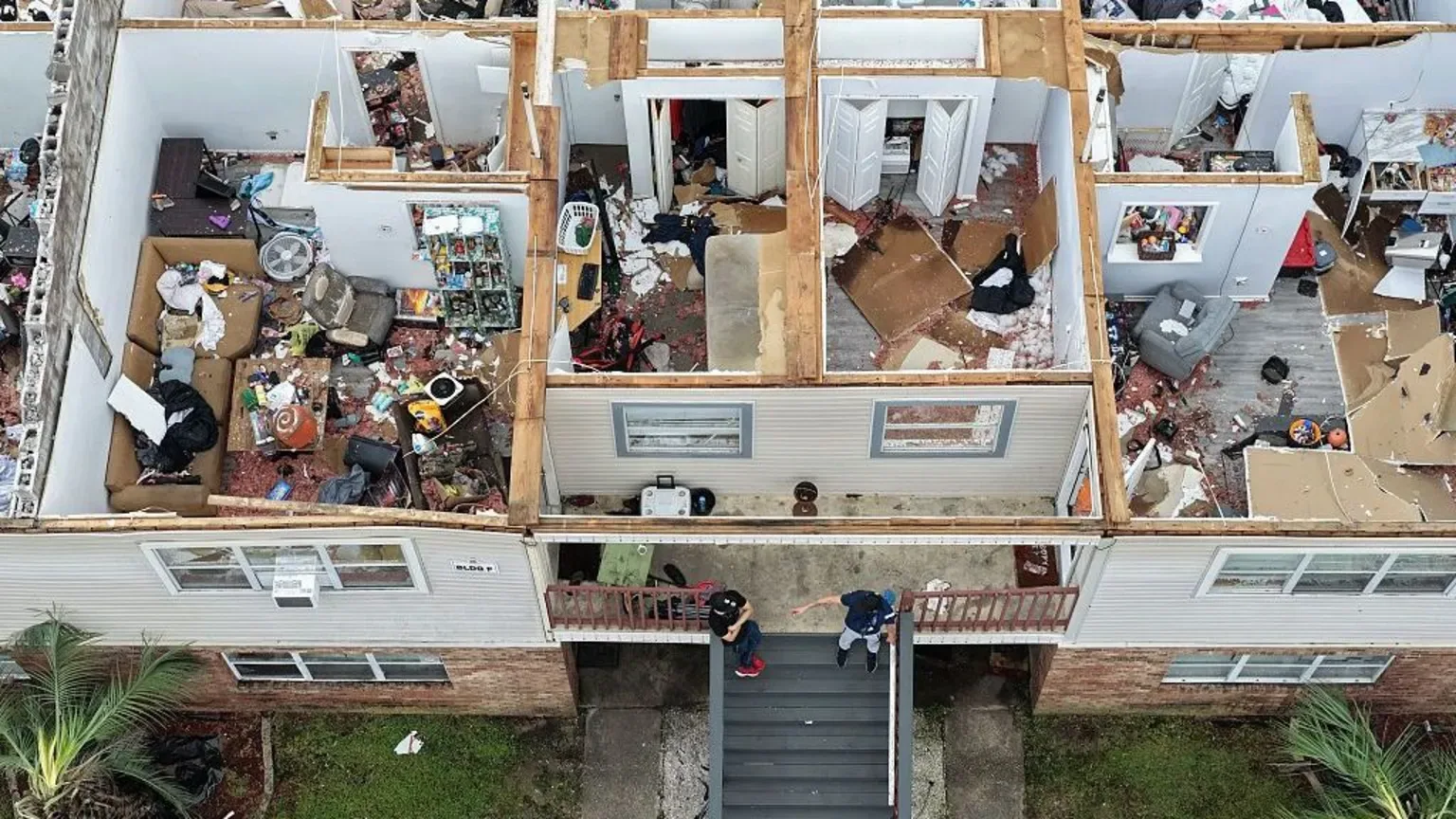
After wind like that, we check uplift first: perimeter securement, the corners where a membrane lifts first, loose coping, shifted rooftop units and curbs that no longer sit square. Then we look for water that got in under a lifted edge and is still traveling through the insulation. A hurricane damage repair starts with a temporary dry-in on the same day when the weather allows, with photographs taken before anything is moved. Those photographs are the backbone of an insurance claim, and they are much harder to produce after a second rain.
Close Out With a File the Next Owner Can Read
The last day of a job is a handoff, not a pickup. We close out with a written record: photographs of the deck and substrate as found, a count and map of penetrations, the drain locations, the details at the edges and the units. A building owner who plans capital spending can use that record without calling us back. A roof condition report turns the same findings into a repair-or-replace schedule that a budget meeting can follow.
Price and timing both move with the same short list: how much insulation is wet, what the deck looks like once the membrane comes off, how far the crane has to reach, whether work happens during tenant hours, and how long the chosen material takes to arrive. We name those drivers up front. Each one has an answer after a commercial roof inspection, and none of them has to be a surprise.
Commercial Roofing Questions
Our building backs up to the water. Does that change how the drains get maintained?
Rain falls the same across the Houston area. What shifts near open water is humidity and how fast metal corrodes, so we check the drain baskets, scupper edges and fastener heads for rust as well as debris. Clear them before June, the wettest month, and again after any named storm.
What does a first walk on a Nassau Bay roof actually cover?
We look at the field of the membrane, the seams, the edges, every penetration and every drain. A moisture scan maps wet insulation where a leak has been traveling. We also walk the ground: where the crane could stand, where material could be staged, and which entrances must stay open. The result is a written scope with photographs.
Can a leak near the Space Center side of town be patched, or does the whole roof have to go?
Often a section repair holds for years, provided the insulation under it is dry and the membrane around it still welds or bonds well. A moisture survey separates a roof with one bad flashing from a roof that is wet across its field. Only the second case moves toward recover or replacement.
How do you phase a reroof when tenants cannot lose a single day?
We open the roof in strips, close each strip before the crew leaves, and hold the hot work permit to the hours when the area below is cleared. Deliveries are timed to the tenants' quiet hours. Where a space truly cannot be disturbed, that section goes to a night shift or a weekend window.
Why would a recover cost less than a tear-off on the same roof?
A recover skips removal and disposal of the old system, which saves labor, dump fees and crane time. It only works if the insulation beneath is dry and the deck is sound, so the moisture survey comes first. If wet insulation shows up, the savings disappear because the wet material has to come out anyway.
Keep Reading
Related Roofing Work in Pasadena


Walk the Site With Us
Bring the facility director, the tenant schedule and any leak log you have kept. We will walk the roof and the lot together so the work plan fits your operation before anyone mobilizes.